Modular Data Centers For Sale. Built. Tested. Ready to Deploy.
Actual inventory — staged, deployment-ready
Contact our team for current modular data center availability. 900 kW IT power, 96 racks, 5,500 sq ft per unit, ICD-705 design basis with TEMPEST/RF shielding. On your pad in weeks, not years.
Skip the 12–18 month new-build timeline. A prefabricated data center in hand means deployment in weeks, not years.
SCIF Pathway
ICD-705 design basis. SCIF accreditation pathway for defense and IC missions.
Global Logistics
Standard 20-ft ISO data center container format. Truck, rail, ship, or airlift to any site worldwide.
Proof of Capability · Modular Data Center For Sale
Contact for Modular Data Center Availability
We don't just say we can deploy — the units are built, tested, and staged. Each 900kW modular data center is hyperscale-grade infrastructure manufactured by Silent-Aire/JCI for Azure deployment: a complete, self-contained containerized data center in standard 20-ft ISO sections.
The units are built on Silent-Aire’s hyperscale modular platform — factory-integrated Server Room Modules (SRM) and Power Room Modules (PRM) from the same product family Silent-Aire deploys for hyperscale cloud operators worldwide.
Why Modular, Why Now — The Market Clock
55 months
Median time from interconnection request to commercial operation for U.S. grid projects completed in 2024. Grid access — not compute — is the constraint.
Source: Lawrence Berkeley National Laboratory, Queued Up: 2025 Edition (Dec 2025). Retrieved Aug 2026.
1.4%
North America primary-market data center vacancy at the end of 2025 — a record low. Existing capacity is effectively spoken for before it is built.
Source: CBRE, North America Data Center Trends H2 2025. Retrieved Aug 2026.
7 in 10
Americans who say they would oppose a large AI data center in their own community — siting a new mega-campus keeps getting harder.
Source: Gallup, U.S. adults survey (Mar 2026). Retrieved Aug 2026.
2030
The year AI inference is projected to overtake training as the dominant workload — demand that lands distributed and closer to users, in exactly the increments modular delivers.
Source: McKinsey & Company, The next big shifts in AI workloads and hyperscaler strategies (2025). Retrieved Aug 2026.
Conventional Campus Build
TimelineMulti-year program — design, entitlement, construction, commissioning.
LandLarge parcels — campus-scale programs measured in acres, plus buffer and expansion holds.
Power CommitmentLarge upfront utility commitment negotiated years ahead of first load.
Failure DomainCapacity concentrated in a single campus and construction schedule.
Site FrictionGreenfield entitlement, permitting, and community process before ground breaks.
DDCD Modular Node
TimelineWeeks once the site is ready — the units are already built, tested, and staged.
Land5,500 sq ft per unit on a prepared pad.
Power CommitmentPhased 900 kW increments, with an engineered full high-density conversion pathway to up to 4.8 MW per unit.
Failure DomainDistributed — deploy units across sites and regions as demand lands.
Site FrictionPreviously developed, power-ready industrial sites are strong candidates.
Per-unit specifications — 900 kW modular data center
IT Power
900 kW per unit* · up to 4.8 MW with full conversion
Rack Capacity
96 racks per unit
Rack Architecture
4 rows × 24 racks — 225 kW per row (≈9.4 kW average per rack as designed)
Footprint
5,500 sq ft per unit
Format
Standard 20-ft ISO container sections
Transportable Sections
9 sections per unit. Each section ships on a standard flatbed trailer.
Manufacturer
Silent-Aire / Johnson Controls — built for Azure hyperscale deployment
300 kVA PDU transformers with branch-circuit monitoring; factory-installed primary & secondary busway
Transfer Switching
Automatic transfer switches (ATS) and static transfer switches (STS), factory-integrated per unit
UPS
Mitsubishi, N+1 — 1050 kVA modules
Cooling
6 CRAH units per server module — direct-expansion (DX), 25,500 CFM, N+1, variable-frequency fan drives
Switchgear
Eaton, dual-source
Shielding
TEMPEST/RF
Fire Suppression
Novec 1230 clean-agent system (NFPA 2001); NFPA 72 detection
Controls
Distech BACnet
Security Basis
ICD-705 design basis
Power Upgrade Pathway
Up to 4.8 MW per unit via full high-density conversion — 96 racks × 50 kW, a new basis of design that substantially improves unit economics. Engineering pathway details in the full package.
* Base configuration is 900 kW IT load as built. Each unit can be converted to up to 4.8 MW IT via full high-density conversion — 96 racks × 50 kW, a new basis of design — a step-change in usable capacity and economics versus the as-built rating. Engineering pathway details in the full package.
Density Ladder — Base Today, Higher Density by Engineering
Every figure on this ladder carries its tier. Base figures are verified against as-built records. Conversion path rungs stage the full high-density conversion to up to 4.8 MW per unit — engineered per project, with pathway details in the full package.
Stage 01
Base — verified
Baseline Node
900 kW IT · 96 rack positions — as built
The unit as it sits in inventory today, verified against as-built records and OEM documentation. Deployable now — and the launch point for the staged conversion pathway.
Stage 02
Conversion path
Bounded Pilot Zone
Per-stage figures in final engineering
A bounded high-density zone inside the as-built envelope — proves the power and cooling approach on a subset of rack positions before any wider conversion.
Stage 03
Conversion path
Staged Regional Upgrade
Per-stage figures in final engineering
Conversion expands zone by zone with the unit in service, sequenced against workload commitments.
Stage 04
Conversion path
Full High-Density Conversion
Up to 4.8 MW IT · 96 positions × 50 kW
A new basis of design — new power train, expanded utility service, and heat-rejection changes including liquid-cooling options. Engineering pathway details in the full package.
High-Density AI Pathway
Full high-density conversion — up to 4.8 MW IT per unit · updated August 10, 2026
For AI inference, fine-tuning, and dedicated GPU clusters, each unit carries an engineered full high-density conversion pathway for the 96-position hall. It is a new basis of design — a new power train, expanded utility service, and heat-rejection changes including liquid-cooling options — not a modification of the as-built unit. The conversion basis is 96 positions at 50 kW — up to 4.8 MW IT per unit. Engineering pathway details are provided in the full package.
Base — verified
As-Built Configuration
900 kW IT per unit across 96 rack positions — verified as-built
Air-cooled hall with containment, N+1 power train — verified against as-built records
Deployable today
Conversion — up to 4.8 MW IT
Full High-Density Conversion
A new basis of design: new power train and expanded utility service
Heat-rejection changes including liquid-cooling options for GPU-class racks
Conversion basis: 96 positions × 50 kW — up to 4.8 MW IT per unit
Concept — how the two configurations separate
The two tiers never blend on this page: base figures are verified as-built records; conversion figures describe the engineered upgrade program, scoped per project during diligence with pathway details in the full package.
Contact for availability96-rack capacity · N+1 cooling · RF-shielded · ICD-705 design basis · qualified buyers only
⚡ Power Infrastructure
Dual-source critical power with full redundancy.
900 kW IT load per unit* — upgradeable to up to 4.8 MW via full conversion
Dual-feed switchgear (utility + generator)
UPS with battery backup (Mitsubishi)
A+B power feeds to every rack via overhead busway
400V 3-phase + neutral distribution
Reserve PRM modules for N+1 backup
❄ Cooling System
Custom DX cooling with free-cooling capability.
6× CRAC units per SRM (N+1 redundancy)
60-ton dual-stage condensing units
Digital scroll compressors
Free-cooling mode with rooftop exhaust
Hot/cold aisle containment (3 cold, 2 hot)
Evaporative humidifiers for climate control
🔒 Security & Construction
SCIF accreditation pathway with RF shielding.
ICD-705 design basis
RF-shielded enclosure
Clean agent fire suppression
Distech BACnet building controls
BAS/EPMS ready for integration
Standard 20-ft ISO container sections
One Facility. 9 Transportable Sections.
Each unit arrives as 9 factory-integrated sections — IT halls, cooling and power distribution, a utility corridor, and dedicated power rooms — set on a prepared pad with standard rigging and joined through pre-engineered mechanical and electrical interfaces, with weather hoods sealing every inter-section joint.
IT hallsCooling + power distributionUtility corridorPower rooms — switchgear · UPS
9 transportable sections per unit. Each section ships on a standard flatbed trailer.
Massing and zoning abstraction, not a construction drawing — see the assembled unit in the photos below. Controlled drawings are released with the full technical package under NDA.
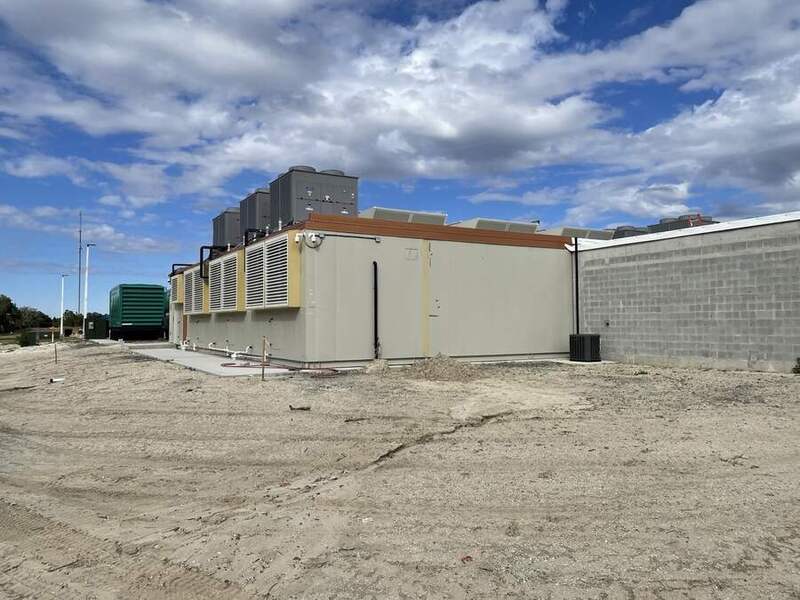
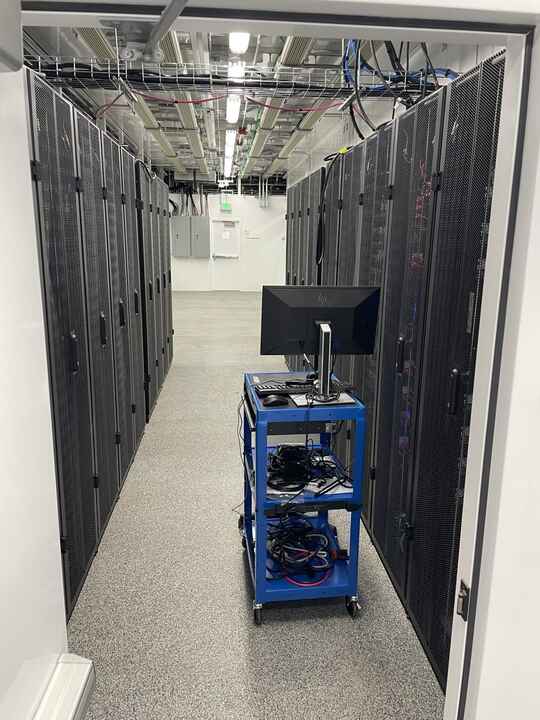
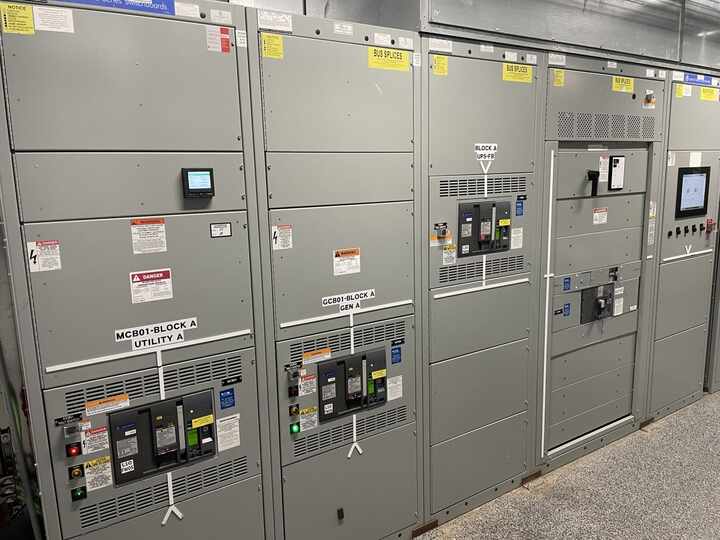
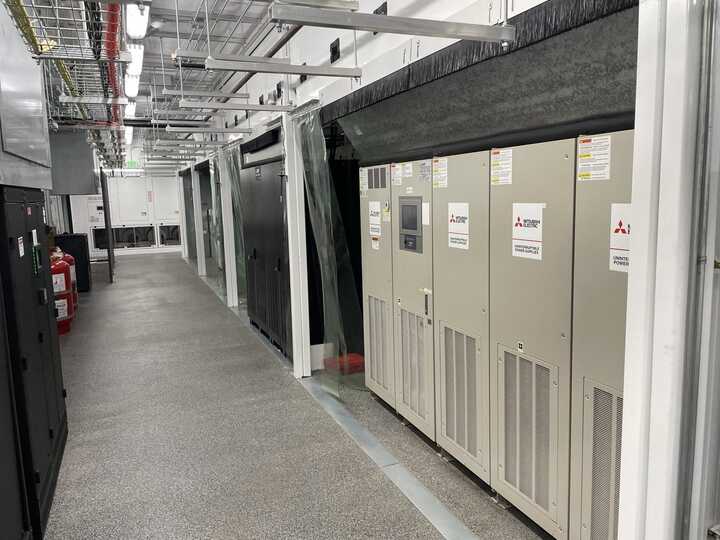
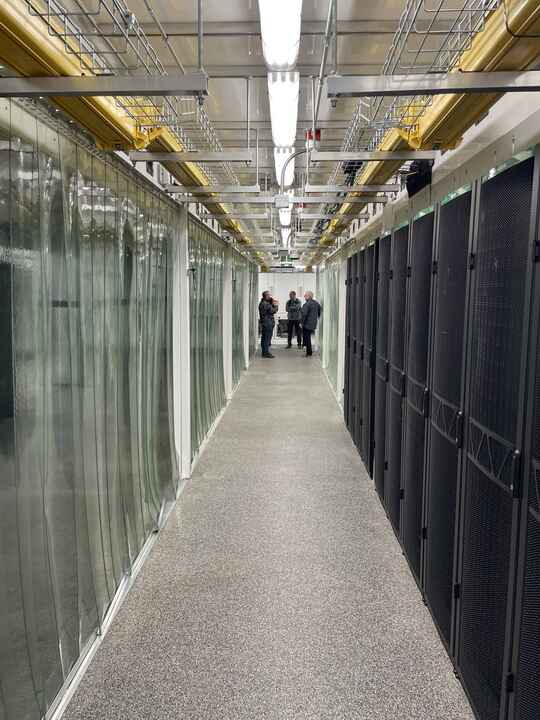
Assembled unit — staged on padIT hall — 96-rack capacityEaton dual-source switchgear
The platform's containerized format, RF shielding, and ICD-705 design basis make these units well suited to edge data center deployments, JADC2-aligned command-and-control compute at the tactical edge, disaster-recovery capacity, AI/HPC expansion, and other defense-grade missions where speed of deployment is the deciding factor.
The schedule clock starts when the Site Ready Certificate is signed — every stage after that is a gated milestone with a written checklist, not a promise. Expand any stage for its gate checklist.
1
Site Ready CertificateClock starts
2
Transport
3
Assembly
4
Integration
5
Commissioning
6
Ready for Load
1
Site Ready Certificate — the schedule clock starts here
Gate checklist
Executed site-control and access agreements
Zoning / permitted-use determination for data center operation, in writing
Utility power confirmed in writing — capacity, voltage, delivery point
Pad and civil works complete to specification — grading, drainage, grounding
Crane and rigging access route confirmed
Fiber path identified with carrier commitments
2
Transport
Gate checklist
Section-by-section load plan — each section ships on a standard flatbed trailer
Route survey, permits, and escort requirements cleared
Receiving-site laydown and staging plan agreed
Insurance and chain-of-custody documentation in place
3
Assembly
Gate checklist
All 9 sections set on the pad with standard rigging
Pre-engineered mechanical and electrical interfaces joined between sections
Weather hoods sealed at every inter-section joint
Envelope inspection — weather-tight sign-off
4
Integration
Gate checklist
Utility power terminated at the dual-source switchgear
Generator connection where site-provided
Fiber terminated and tested to the meet-me point
BAS/EPMS integrated with the buyer’s monitoring stack
5
Commissioning
Gate checklist
Functional performance testing under load banks
Cooling performance verified through N+1 rotation
UPS and source-transfer testing — utility and generator
Fire suppression and controls acceptance
Punch list closed; documentation package delivered
6
Ready for Load
Gate checklist
Acceptance certificate countersigned
Racks energized on A+B feeds
Handover to operations — an additional data hall on your estate, not an operational island
What the clock does and does not include: the schedule clock starts at a signed Site Ready Certificate. Permits, utility service and demarcation, fiber construction, and route/crane access are buyer and site gates that run before certification — they are verified in writing, never assumed.
Powered-Site Scenario — Verification First
Previously powered industrial sites can bring real assets to a deployment. None of them are assumed: the columns below separate what a site can offer from what we verify in writing before any schedule commitment.
What a qualified site can bring
An existing utility relationship and service history
Industrial zoning history and prior AHJ contact
Transformers, switchgear, and distribution already on site
A security presence and controlled perimeter
Fiber in or adjacent to the right-of-way
Disturbed, previously developed land
What we verify in writing before any schedule commitment
Zoning / permitted-use determination for data center operation
Utility capacity confirmation — capacity, voltage, delivery point
AHJ determinations for the change of use
Grounding and drainage against the unit specification
Carrier diversity and the physical fiber path
Community engagement posture and known constraints
Hard line: prior industrial approval — including previously powered digital-infrastructure use — is never treated as authorization for data center operation. Every gate is re-verified for this use, in writing.
Powered-site deployment phases and the gate each must pass
Phase
Gate to pass
Primary owner
Site qualification
Written verification: zoning for data center use, utility capacity confirmation, AHJ determinations, grounding and drainage, carrier diversity
Buyer + DDCD
Construction release
Site Ready Certificate executed — pad, power, access, and fiber committed in writing
Buyer
Transport + assembly
Sections delivered, set, and joined; envelope weather-tight
DDCD
Energization
Utility termination, protective coordination, first power
Buyer’s utility + DDCD
Ready for Load
Commissioning complete; acceptance countersigned
DDCD + Buyer
Production
Workload migration on the buyer’s schedule
Buyer
Deployment Programs
Four Ways to Deploy
Self-select the program that matches your site and mission. No pricing on this page — commercial terms are released with the full package under NDA.
Program 01
Campus Node — 30-Day Target
A modular unit added to an existing campus or facility where power, pad, and fiber are already in hand. The 30-day target clock starts only at a signed Site Ready Certificate — never an unconditional delivery promise.
Deployment at a previously powered industrial site — existing utility relationships, transformers, and disturbed land put to work after written verification of every site gate.
Verification-first: zoning, utility confirmation, and AHJ determinations in writing before any schedule commitment.
An Additional Data Hall, Not an Operational Island
A DDCD unit joins the estate you already operate. Integration is a scoped workstream across six surfaces — planned with your operations team before Ready for Load, not discovered after it.
Integration workstream, not bundled deliverables: each spoke is scoped, owned, and scheduled with the buyer’s operations team during the Integration milestone of the deployment roadmap. Point mapping, monitoring hand-off, and records of truth are agreed in writing before commissioning closes.
Acceptance Ladder — What “Done” Means
Five acceptance states, each with its own written evidence. Buyers are quoted schedules against the wrong state often enough that we define the language up front.
State 1
Site Ready
Site Ready Certificate countersigned — pad, power, access, and fiber verified in writing. The deployment clock starts here.
State 2
Mechanical Completion
Sections set and joined, envelope weather-tight, mechanical sign-off recorded.
State 3
Ready for Load
Commissioning complete and acceptance certificate countersigned — racks may energize on A+B feeds.
Infrastructure state
State 4
Infrastructure Service Ready
Estate integration complete — EPMS and BMS points mapped, NOC/SOC monitoring live, DCIM and CMDB records loaded, ITSM processes cut over.
State 5
Production Ready
Workloads migrated and in service on the buyer’s schedule — declared by the buyer, supported by DDCD.
Business outcome
Ready for Load and Production Ready are never conflated. Ready for Load is an infrastructure state DDCD certifies with commissioning evidence. Production Ready is a business outcome on the buyer’s migration schedule. Quoting one as the other is how modular projects earn bad reputations — we won’t do it.
Photo Gallery
The Containerized Data Center Platform
Actual photos of the modular data center units — exterior, IT hall, power train, containment, and switchgear.
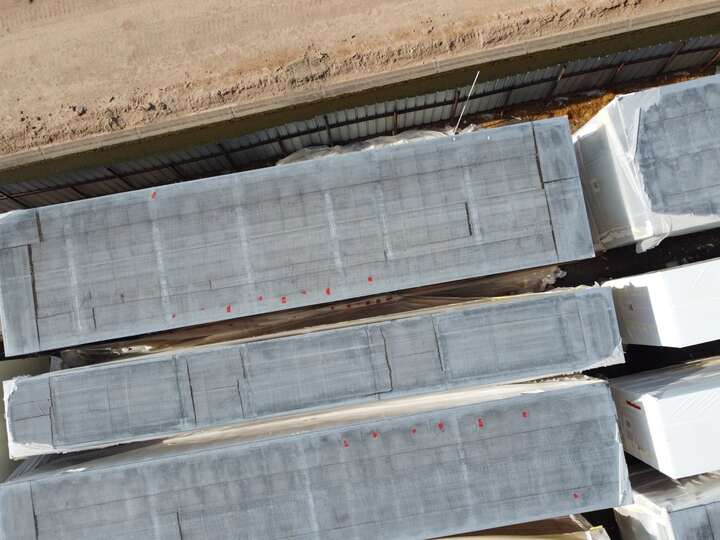
Exterior — Assembled UnitFully assembled prefabricated data center on pad, rooftop cooling and utility connections in place.IT Hall InteriorRack rows with overhead busway and structured cabling — 96-rack capacity per unit.UPS / Power CorridorMitsubishi UPS modules and critical power distribution corridor.Aisle ContainmentHot/cold aisle containment — 3 cold aisles, 2 hot aisles per unit.Main SwitchgearEaton dual-source breakers with digital metering — utility + generator feeds.Inventory AerialWrapped modular sections staged in storage.
Capabilities
A Full-Stack Development Command
Doctrine Data Center Development Company is a civilian contractor that develops and deploys large-scale data center and modular data infrastructure — including facilities built to an ICD-705 design basis with a SCIF accreditation pathway. From ground-up campus development to containerized data center units shipped from inventory — one accountable structure across the entire deployment sequence.
01 / Build
Data Center Construction
Ground-up development of large-scale data center campuses with rigorous adherence to mission timelines and hardened-facility standards.
02 / Modular
Modular & Prefab Deployment
Pre-engineered prefabricated data center halls and edge data center units shipped from ready-to-deploy inventory — site to live load in a fraction of a conventional schedule.
03 / Secure
SCIF-Rated Facilities
Secure facility development to ICD-705 design standards for defense-grade, intelligence-community, and classified-mission requirements.
04 / Procure
Infrastructure Procurement
Sourcing and procurement of data center projects, equipment, and long-lead infrastructure — leveraging market position to secure capacity others can't.
05 / Represent
Owner's Representative
Representing the owner's interest through every phase — scope, schedule, budget, vendors, and acceptance — with a single accountable command structure.
06 / Operate
Infrastructure Services
Site selection, construction management, commissioning, and lifecycle infrastructure services for sustained operational readiness.
Missions
One Platform. Nine Mission Profiles.
The same deployment-ready 900 kW building block serves defense, AI, enterprise, and edge requirements — anywhere a prepared pad, dual-source power, and network connectivity exist.
M01 / Defense
Secure Federal & Defense
ICD-705 design basis with TEMPEST/RF shielding and a SCIF accreditation pathway — classified-mission compute, JADC2-aligned command and control, and hardened capacity for defense programs.
M02 / AI
AI Inference & Private AI
Private AI infrastructure on your own pad — inference and fine-tuning capacity outside shared cloud, with an engineered full-conversion pathway to up to 4.8 MW per unit.
M03 / Expansion
Campus & Data Hall Expansion
Add a factory-built data hall to an existing campus without launching a multi-year construction program — capacity lands next to the load, on your schedule.
M04 / Enterprise
Enterprise Hosting & Consolidation
Consolidate aging server rooms or exit colocation into owned, hardened infrastructure with hyperscale-grade power and cooling.
M05 / Continuity
Disaster Recovery & Continuity
Stand up a geographically separated disaster recovery data center in weeks — independent power train, shielded enclosure, and a full N+1 mechanical plant.
M06 / Swing
Migration & Swing Capacity
Swing capacity during renovations, migrations, or lease exits — deploy, run the transition, then redeploy the unit to its next mission.
M07 / Regional
Regional Cloud & Availability Zones
Seed new regions or availability-zone shells with a repeatable 900 kW node — standardized, transportable, and expandable in phased increments.
M08 / Edge
Telecom & Network Edge
Edge data center capacity at network aggregation points — low-latency compute where traffic terminates, in a standard ISO transportable format.
M09 / Storage
Storage & Replication
High-capacity storage and replication nodes for data-sovereignty, backup, and archive requirements — RF-shielded and access-controlled.
Channel Partners
Consignment & Brokerage
DDCD offers consignment and brokerage arrangements for qualified partners to represent and resell this equipment. If you're a dealer, systems integrator, or infrastructure broker with buyers who need a modular data center for sale right now, let's structure a channel that works.
A / Dealer & Integrator Channel
Resell From Our Inventory
Qualified dealers and integrators can offer deployment-ready 900kW containerized data center units to their own customers — with DDCD handling logistics, technical diligence support, and delivery.
B / Consignment
Consignment Arrangements
Place units into your sales program under a consignment structure — inventory stays staged and deployment-ready while your channel works qualified buyers.
C / Brokerage
Brokerage Representation
Infrastructure brokers with active mandates — data center capacity, edge compute, defense-grade facilities — can represent the inventory to their buyer network under a brokerage agreement.
Partnership terms are discussed directly with qualified parties. Request the full package and note your channel interest in the form.
Leadership
Principals & Advisors
Operators with skin in the game — the same people who source, own, and deploy the infrastructure lead every engagement.
RM
Ryan Muranaka
Partner, Managing Director — Doctrine Data Center Development Company
Ryan Muranaka is a Partner and Managing Director of Doctrine Data Center Development Company, and a Managing Director at MainGrid Infrastructure, leading the fund's data center development strategy. He has played a key role in developing multiple large-scale, high-density data centers, has direct experience negotiating power agreements with electric utilities, and oversees the management of the fund's high-density computing fleet. He also brings more than 20 years of experience in commercial real estate bridge financing, having overseen more than $2 billion in directly originated secured real estate loans across various asset classes — including loan origination and asset management roles with YAM Capital and IMH Financial Corporation, where he was affiliated for 15 years. He holds a BS in Business & Communications from Arizona State University.
AB
Andreas Bodmeier, Ph.D.
Partner
Andreas Bodmeier is a Partner of the MainGrid Infrastructure Fund and has worked at the intersection of finance and analytics for over 15 years. He is a co-founder of Chicago Atlantic, an institutional investment firm, where he serves as a Partner and as President of Chicago Atlantic Real Estate Finance, Inc. (Nasdaq: REFI). He previously co-founded a boutique technology and consulting firm focused on FX and commodity risk management, and co-founded an SEC-registered online investment adviser where he served as Chief Investment Officer and Chief Compliance Officer. He holds a Ph.D. in Finance and an MBA from The University of Chicago Booth School of Business.
MC
Michael Carter
Partner & Head of Operations
Michael Carter is a Partner and Head of Operations. He brings more than 24 years of Fortune 500 experience in information technology and business operations, including more than 11 years of direct, hands-on operational experience with high-density data center facilities, and is a senior technology leader and solution architect with General Dynamics Information Technology (GDIT). He has advised organizations around the world on data center facility architecture and design, including a $2+ billion global operator, and led the construction of a prototype 2-megawatt high-density computing facility housing more than 2,500 GPUs.
Frequently Asked Questions
Modular Data Center FAQ — Pricing, Lead Times, SCIF Accreditation
How much does a 900 kW modular data center cost?
Unit pricing and commercial terms are provided in the full technical package, released under mutual NDA — typically within one business day of a qualified request.
How fast can a unit be delivered?
The units are built, factory-integrated, and staged — in stock and available for immediate delivery, with no multi-year construction lead time. Overall schedule is measured in weeks, not years, and depends primarily on site readiness: pad, power, and network.
Are the units SCIF-certified?
The units are built to an ICD-705 design basis with TEMPEST/RF shielding. A Sensitive Compartmented Information Facility (SCIF, pronounced “skiff”) is accredited by the cognizant government authority; we support that accreditation pathway.
Can the 900 kW units be upgraded?
Yes. Each unit ships at 900 kW IT load and can be upgraded to up to 4.8 MW per unit via a full high-density conversion — 96 racks at a 50 kW target — a step-change in usable capacity and unit economics versus the as-built rating. The conversion is a new basis of design engineered per project; engineering pathway details are in the full package.
What is the condition and provenance of the units?
The units were manufactured by Silent-Aire (Johnson Controls) for an Azure hyperscale deployment and are staged and deployment-ready. Full documentation and the complete photo library are provided in the technical package.
What site infrastructure is required?
Each unit is designed for dual-source power — utility plus generator feeds — on a prepared pad with network connectivity. Detailed site requirements are included in the full technical package.
What electrical infrastructure is included with each unit?
Each 900 kW unit ships with its power train factory-integrated: N+1 UPS (1050 kVA modules), 300 kVA PDU transformers with branch-circuit monitoring, automatic and static transfer switches, and primary/secondary busway distribution at 480V 3-phase. The dual-source topology accepts utility and generator feeds; site generators are furnished at deployment.
How are the units cooled?
Each server room module is cooled by six CRAH units delivering 25,500 CFM in an N+1 configuration — self-contained direct-expansion (air-cooled) with variable-frequency fan drives and hot-aisle containment. The 900 kW design point supports 96 racks at approximately 9.4 kW per rack average; higher-density configurations are addressed in the full technical package.
How fast can a unit actually be on load?
The deployment roadmap runs Site Ready Certificate → Transport → Assembly → Integration → Commissioning → Ready for Load. The schedule clock starts when the Site Ready Certificate is signed; permits, utility work, fiber, and crane access are buyer and site gates verified before certification. Because the units are already built and staged, the on-site schedule is measured in weeks, not the years of a ground-up build.
Can the units support high-density AI racks?
The as-built unit is verified at 900 kW IT across 96 rack positions (approximately 9.4 kW per rack average). For GPU-class racks, a full high-density conversion takes each unit to up to 4.8 MW IT — 96 positions at a 50 kW target. The conversion is a new basis of design with a new power train, expanded utility service, and heat-rejection changes including liquid-cooling options; engineering pathway details are in the full package.
Request the Full Technical Package
Complete specification set, unit documentation, photos, and acquisition details for the 900kW modular data center inventory — delivered to qualified parties under a mutual confidentiality agreement.
Whether you need a facility developed from the ground up or prefabricated data center units deployed from inventory in weeks — start the conversation. Serious and qualified inquiries only.